




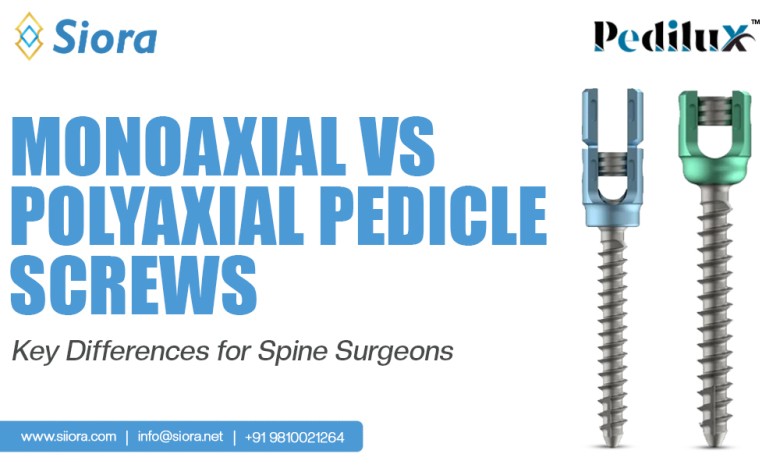
Pedicle screw fixation has become a standard part of modern spine surgery. Whether treating spinal instability, trauma, deformity, or degenerative conditions, surgeons rely on pedicle screw systems to achieve stable fixation and proper alignment. Among the available options, monoaxial and polyaxial pedicle screws are the two most commonly used designs. Although both serve the same basic purpose, their mechanical behavior and surgical handling are quite different. Understanding these differences helps surgeons choose the right system for each clinical situation.
Understanding Monoaxial Pedicle Screws
Monoaxial pedicle screws have a fixed head. Once the screw is inserted into the pedicle, the head remains in a single position without movement. Because of this rigid structure, monoaxial screws provide strong correction forces and better control during deformity correction procedures.
These screws are commonly preferred in situations where precise alignment and rigid fixation are important. Since the screw head does not move, the force applied through the rod is transferred directly to the vertebra. This can help achieve stronger rotational and sagittal plane correction.
However, rod placement may become technically demanding. The fixed screw heads require accurate alignment during insertion, and even slight variation in screw trajectory can make rod seating difficult.
Understanding Polyaxial Pedicle Screws
Polyaxial pedicle screws are designed with a movable head. The head can rotate in multiple directions, allowing easier connection between the screw and rod. This flexibility simplifies rod placement during surgery and reduces the need for perfect screw alignment.
Because of their ease of handling, polyaxial screws are widely used in routine spinal fixation procedures. They are especially helpful in minimally invasive surgeries and multilevel fixation cases where rod contouring and alignment can be challenging.
Although polyaxial screws provide excellent versatility, they may offer slightly less corrective force compared to monoaxial screws due to the movable head mechanism.
Key Mechanical Differences
The main difference between the two systems lies in rigidity and flexibility. Monoaxial screws behave as a fixed construct, while polyaxial screws allow movement at the screw head before final locking.
Monoaxial screws generally provide:
- Stronger deformity correction
- Better rotational control
- Greater construct rigidity
Polyaxial screws mainly offer:
- Easier rod insertion
- Better adaptability during surgery
- Reduced technical difficulty
The choice often depends on whether correction strength or surgical convenience is the primary goal.
Surgical Applications
Monoaxial screws are commonly used in spinal deformity correction, especially in scoliosis procedures where controlled vertebral manipulation is required. Their rigid design allows surgeons to apply corrective forces more effectively.
Polyaxial screws are more frequently used in degenerative spine surgery, trauma stabilization, and minimally invasive procedures. Their flexible heads make them suitable for multilevel constructs and situations where screw trajectories vary.
In many modern systems, surgeons may even combine both screw types in the same construct depending on the surgical objective.
Factors Influencing Implant Selection
Several factors influence the choice between monoaxial and polyaxial screws, including:
- Type of spinal pathology
- Bone quality
- Number of fixation levels
- Need for deformity correction
- Surgical approach and surgeon preference
Experience also plays a role. Some surgeons prefer the rigid feel of monoaxial systems, while others prioritize the convenience and flexibility of polyaxial fixation.
Conclusion
Both monoaxial and polyaxial pedicle screws have important roles in spine surgery. Monoaxial screws provide stronger correction and rigid fixation, while polyaxial screws offer easier handling and greater flexibility during rod placement. Neither trauma implant system is universally better than the other. The ideal choice depends on the surgical goal, patient anatomy, and the surgeon’s technique. A clear understanding of their differences helps spine surgeons achieve stable fixation and better clinical outcomes.













Facebook Conversations
Disqus Conversations