




Cracking the Code: What Every Agri-Exporter Should Know About APEDA Registration
India's agricultural and processed food export sector is booming, but stepping into international trade isn't as simple as finding a buyer and shipping a container. There's a regulatory gatekeeper that every exporter of scheduled agricultural products must deal with first: APEDA. If you've been hearing the term thrown around in exporter circles and aren't entirely sure what it involves, this guide breaks down everything you need to know, from what the registration actually is to how much it costs and where to get expert help.
What Is APEDA?
APEDA stands for the Agricultural and Processed Food Products Export Development Authority, a body established under the APEDA Act, 1985, and operating under India's Ministry of Commerce and Industry. Its mandate is to promote and regulate the export of scheduled products, which include fruits, vegetables, meat, poultry, dairy, cereals, confectionery, and a wide range of processed food items.
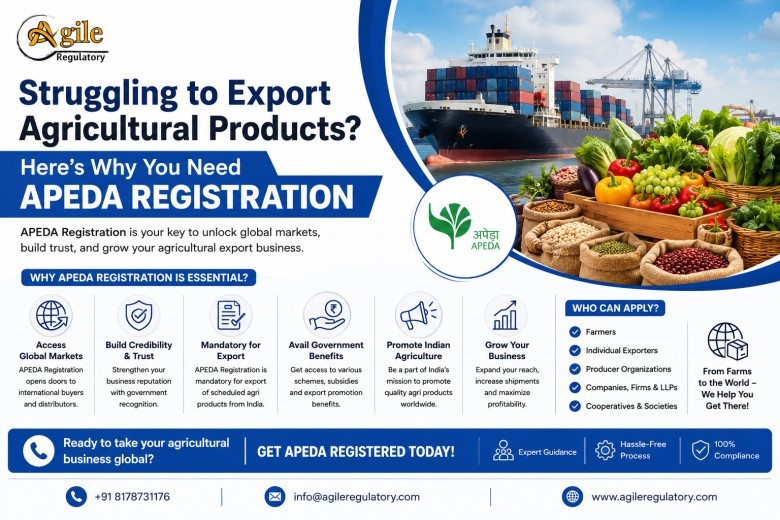
For any business looking to export these categories, apeda registration isn't optional — it's a legal prerequisite. Without it, customs authorities simply won't clear your shipment, no matter how solid your export order or buyer relationship might be.
Understanding the APEDA Certificate
The apeda certificate, formally known as the Registration-Cum-Membership Certificate (RCMC), serves as official proof that your business is registered with APEDA and authorized to export scheduled products. This certificate does more than satisfy a legal requirement; it acts as your gateway to a range of government-backed benefits, including financial assistance schemes, market development support, and access to APEDA's export promotion programs like trade fair participation and buyer-seller meets.
Many exporters mistakenly assume that a GST registration or an Import Export Code (IEC) is enough to begin exporting agricultural goods. In reality, the apeda license is a separate and equally essential requirement specifically for scheduled product categories, layered on top of your existing business registrations.
Who Needs APEDA Registration?
APEDA registration applies broadly to:
- Manufacturers and processors of scheduled food products
- Merchant exporters trading in agricultural commodities
- Farmers' cooperatives and producer organizations exporting directly
- Businesses exporting fresh fruits, vegetables, meat, poultry, dairy, cereals, and processed foods
- Companies exporting alcoholic beverages, floriculture products, and other listed items under APEDA's schedule
If your export catalog includes even one item from APEDA's scheduled list, registration becomes mandatory before you can legally ship that product overseas.
Documents Required for APEDA Registration
Before starting the apeda application, gather the following documents:
- Import Export Code (IEC) issued by DGFT
- PAN card of the business entity
- GST registration certificate
- Bank certificate or cancelled cheque for the current account
- Certificate of incorporation, partnership deed, or proprietorship proof, depending on business structure
- Bank account details linked to the business
- Application fee payment proof
Having these ready in advance significantly reduces back-and-forth during processing, since incomplete documentation is one of the most common reasons applications stall.
Step-by-Step: The APEDA Application Process
Step 1: Access the APEDA Application Form
The registration process begins with the apeda application form, available on APEDA's official online portal. This form captures core business details, product categories, and bank information.
Step 2: Upload Supporting Documents
Scanned copies of IEC, PAN, GST certificate, and bank documents need to be uploaded in the specified format. Consistency across all documents — same business name, same address — is critical here.
Step 3: Pay the Registration Fee
Applicants need to pay the prescribed registration fee, which varies based on business turnover and category. This is where questions around apeda certificate charges and apeda certificate cost typically come up, since fee slabs differ for various turnover brackets.
Step 4: Application Review
Once submitted, APEDA reviews the application and supporting documents. If discrepancies are found, the applicant is asked to provide clarifications or corrected documents before the process moves forward.
Step 5: RCMC Issuance
Upon successful verification, APEDA issues the Registration-Cum-Membership Certificate, which is typically valid for five financial years and needs to be renewed thereafter.
APEDA RCMC: Why It's More Than Just a Certificate
The apeda rcmc isn't just a formality sitting in your files — it actively unlocks tangible business advantages:
- Financial Assistance: APEDA offers subsidy schemes for infrastructure development, quality certification, and packaging improvements for registered exporters.
- Market Development Support: Registered members can access market research reports and country-specific export guidelines curated by APEDA.
- Trade Fair Participation: APEDA regularly organizes and subsidizes participation in international trade fairs, giving registered exporters visibility with global buyers.
- Credibility with Buyers: International buyers often verify RCMC status before finalizing large export contracts, since it signals regulatory legitimacy.
Without a valid RCMC, none of these opportunities are accessible, regardless of product quality or business scale.
Understanding APEDA Certificate Charges and Costs
One of the most common questions from first-time applicants revolves around cost. The apeda certificate charges typically depend on:
- The applicant's business turnover in the previous financial year
- Whether the business falls under general or special category exporters
- Additional charges for late renewal or duplicate certificate issuance
While the government fee itself is relatively modest and structured in tiers, businesses should also factor in the apeda certificate cost associated with documentation preparation, professional consultation, and any corrections needed during the review process. Getting the application right the first time is usually more cost-effective than dealing with delays and resubmissions.
Common Mistakes Exporters Make During APEDA Registration
Even experienced trading businesses run into avoidable hurdles:
- Mismatched business details across IEC, GST, and PAN documents
- Incorrect product classification, leading to registration under the wrong scheduled category
- Outdated bank certificates that don't match current account details
- Delayed renewal, resulting in a lapsed RCMC and interrupted export operations
- Incomplete turnover declarations, which affects fee calculation accuracy
These small errors can add weeks to what should otherwise be a straightforward process.
Why Exporters Choose to Work With an APEDA Consultant
Given how document-heavy and detail-sensitive the registration process is, many businesses prefer working with an experienced apeda consultant rather than navigating it alone. A consultant brings value in several ways:
- Verifying product classification against APEDA's scheduled list before submission
- Ensuring documentation consistency across all supporting files
- Managing the online application process and tracking status
- Advising on accurate fee calculation based on turnover
- Handling renewal timelines so certification never lapses
For exporters juggling production, logistics, and buyer relationships, outsourcing this regulatory piece often saves both time and unnecessary compliance risk.
About Agile Regulatory
Agile Regulatory is a regulatory compliance consultancy that supports Indian businesses across a wide range of licensing and certification needs, including APEDA registration, FSSAI licensing, BIS certification, import-export documentation, and more. When it comes to apeda registration, Agile Regulatory typically manages the process end-to-end — verifying which scheduled category a client's products fall under, preparing and cross-checking documentation, submitting the application through the official portal, and following up with APEDA until the RCMC is issued.
What sets a consultancy like Agile Regulatory apart is the ability to catch documentation mismatches and classification errors before they cause delays, rather than after an application has already been sent back for correction. For exporters unfamiliar with the nuances of scheduled product categories or unsure about fee structures, Agile Regulatory offers clarity and hands-on support, reducing the guesswork that often slows down first-time applicants. This becomes especially valuable for businesses managing multiple regulatory requirements simultaneously, where APEDA registration is just one piece of a larger compliance puzzle involving IEC, GST, and product-specific approvals.
Renewal and Validity: Don't Let Your RCMC Lapse
An APEDA RCMC is typically valid for five years from the date of issuance. Businesses should track this expiry date carefully, since operating with a lapsed certificate creates the same legal exposure as never having registered at all. Renewal involves a similar documentation and fee process, and planning ahead — rather than scrambling close to the expiry date — helps avoid any interruption to ongoing export operations.
Final Thoughts
For any business exporting scheduled agricultural or processed food products from India, APEDA registration in up isn't a bureaucratic afterthought — it's a foundational requirement that determines whether your goods can legally leave Indian shores. From understanding the application form to budgeting for certificate charges and staying on top of renewal timelines, getting the process right the first time saves significant time, money, and operational disruption. Given the documentation-heavy nature of the process, many exporters find real value in partnering with experienced consultants such as Agile Regulatory, who can guide the application from start to finish and help avoid the common pitfalls that trip up first-time applicants.
Frequently Asked Questions (FAQs)
Q1: What is APEDA registration and who needs it?
APEDA registration is a mandatory certification for businesses exporting scheduled agricultural and processed food products from India. It applies to manufacturers, processors, merchant exporters, and cooperatives dealing in these categories.
Q2: What is the APEDA RCMC certificate?
The RCMC, or Registration-Cum-Membership Certificate, is the official document issued by APEDA confirming that a business is registered and authorized to export scheduled products, and eligible for associated government support schemes.
Q3: How do I apply for APEDA registration online?
Applicants need to fill out the APEDA application form on the official portal, upload documents like IEC, PAN, GST certificate, and bank proof, pay the applicable fee, and wait for departmental verification before the RCMC is issued.
Q4: What documents are required for the APEDA application?
Commonly required documents include the Import Export Code, PAN card, GST registration certificate, bank certificate or cancelled cheque, and business incorporation proof.
Q5: How much does an APEDA certificate cost?
APEDA certificate charges vary based on the applicant's business turnover and category. Additional costs may apply for documentation support, corrections, or professional consultation services.
Q6: How long is the APEDA RCMC valid?
The RCMC is typically valid for five financial years from the date of issuance and must be renewed before expiry to continue exporting scheduled products legally.
Q7: Can I export agricultural products without APEDA registration?
No. Exporting scheduled agricultural or processed food products without a valid APEDA license is not permitted, and shipments can be held or rejected at customs without proper registration.
Q8: Should I hire an APEDA consultant for registration?
While businesses can apply on their own, working with an experienced APEDA consultant like Agile Regulatory helps avoid common documentation errors, ensures accurate product classification, and speeds up the overall registration process.














Facebook Conversations
Disqus Conversations